




 |
|
Type: Rocket Interceptor Weight: Length: 6.40 m Engine: 1LPR D-1-A-1100 Top speed: Armament: |
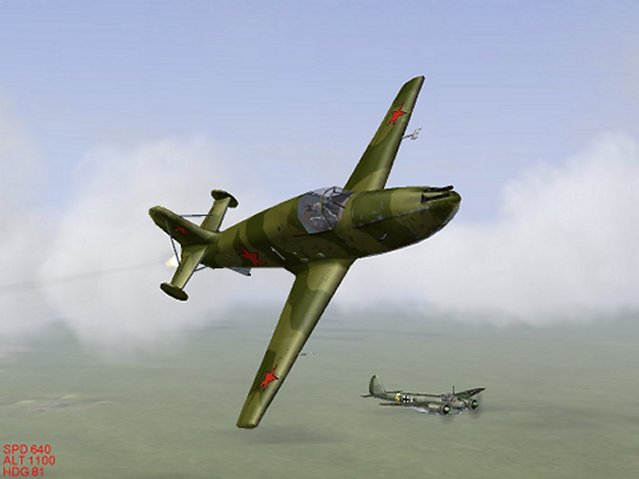
No plane in the world can be compared to BI-1. There are many legends for each prototype that existed. Almost everyone related to aviation has heard stories about it, but very few people know what happened in reality (except for the myths, mystical stories and pure fantasy). History of this planes development, together with people related to it, is full of coincidences and surprises. This aircraft became a legend during its brief life, and still remains an enigma even though many archives have now been opened It was the first battle-ready rocket-powered interceptor in history to go into large-scale serial production. The initial serial production of 40 units was abandoned for many reasons. One of the reasons was that the Germans were not yet able to reach Moscow with their bombers and such an interceptor requiring complex ground service and unable to follow fast- moving front lines was no longer needed. Advantages: high speed and excellent climb rate, easy controls, strong armor against bomber defensive fire. Disadvantages: insufficient maneuverability for horizontal fights against maneuverable fighters, limited time of flight due to quick fuel consumption. Low ammo load. History: Many design bureaus became interested in this new type of engine. Nikolay N. Polikarpovs design bureau was one of them. By that time, he had already tested this type of engine on his aircraft. Other bureaus included Robert L. Bartinis design bureau, which was interested in flights through the stratosphere and Andrey N. Touplevs bureau, whose varied interests were also widely known. This group of scientists, aircraft designers and pilots who had either already flown (or were experimenting with) rocket aircraft was called the rocket-plane group. Victor F. Bolhovitinovs design bureau was one of the first to start working in this new direction. The bureau was created at the Gorbunov Plant # 293 and was initiated by the Zhukovskiy Air Force Academy. The bureau was specifically responsible for dealing with totally new types of aircraft. The first aircraft of this kind was a heavy DB-A bomber. The latter was not entirely successful, since the famous pilot Sigizmound A. Levanevskiy and all his crew were lost during a flight over the North Pole on the polar version of the bomber. Luckily, this misfortune which caused the authorities to draw far-reaching conclusions did not discourage Victor Bolhovitinov. His talented aircraft designers kept developing new prototypes. This fantastic team did not work directly under NKVD supervision and included, at different times, Alexander Y. Bereznyak, Alexey M. Isaev, Vasiliy P. Mishin, Konstantin D. Bushuev, Nikolay A. Pilyugin, Arkhip M. Lyulka, Michael V. Melnikov, Boris E. Tchertok, Arvid V. Pallo, Boris V. Raushenbah and other experienced engineers, aircraft designers and MAI graduates eager to absorb new ideas. These men later went on to become academics and professors, conventional and cruise missiles designers, developers of rocket engines, submarines and spaceships, members of the team that sent the first men into space, designers of missile control systems, authors and pioneer developers of turbojet engines and navigation systems, and so on. Much later, B. E. Tchertok wrote in his book Rockets and People: the historical significance of this productive talent deserves great appreciation from future generations. This appreciation should be no less than that reserved for the production of jet aircraft and rockets. After the TsAGI meeting, where new types of engine were demonstrated, Bolhovitinovs design bureau concentrated its efforts on LPR aircraft. All of the characteristics of the future aircraft were easily apparent from the limitations imposed by the construction of this type of engine: an unusually high capacity and a horizontal speed and climb rate only possible for about 4 minutes of powered flight. Soon all conditions for initial design were agreed upon, and two designers from the bureau began working on the rocket interceptor prototype. The designers were the academic A. Y. Bereznyak, who dealt with aerodynamics, and engine specialist A. M. Isayev. Their interceptor would be designed for an engine from Leonid Doushkins LPR team at NII-3. This institution is better known as the Rocket Scientific and Research Institute (RNII). All work within Bolhovitinovs design bureau was conducted during overtime, in addition to all other orders. The work was divided into two parallel stages: independent airfoil creation and engine design in cooperation with the RNII. In 1940, the engine designers promised a quick fulfillment of the order. The latest and simplest of the projects was approved by the chief designer and was included in the work plan as a secondary priority. In April 1941, the team received separate space to design the aircraft. The project was officially named BI after the designers last names - Bereznyak and Isaev. The aircraft they were working on was a single-seat low-wing plane of mostly wooden construction. The rectangular monolith wing consisted of nine longerons held together with brackets coming around the wings upper and lower contour. Shrenko split landing flaps with a deflection angle of up to 50 degrees were installed on the lower edge of the wing, between the fuselage and the small aileron. The planes tail unit was fairly standard, except for three distinct features: an additional fin between empennage, stabilizer and fuselage; an under-fuselage fin with retractable tailwheel; and round tailplane endplate fins. I. F. Frolov suggested these additions after the first prototype went through aerodynamic and flight tests. Ailerons, wheels and flaps were metal, and fabric-covered. The fuselage for the BI was a wooden semi-monocoque. 5.5mm armored plate was installed in the front of the cockpit. Two 20mm ShVAK cannons were installed in the planes nose in front of the pilot, under a removable cover with fasteners. Each cannon had only 45 rounds of ammo. Two tanks with pressurized air, and two with kerosene, were installed in the lower part of the nose, under the guns. Multiple tanks with nitric acid and air were located behind the cockpit. An LPR D-1-A-1100 was placed in the tail end of plane. Tractor kerosene was used for fuel, and concentrated 96-98% nitric acid as an oxidizer. The acid was transported to the engine by the air pressure from the tanks, at the rate of 4.2kg of acid per 1kg of kerosene. The engine consumed up to 6kg of kerosene and acid per second at maximum thrust. The take-off mass of the BI was 1,650kg, and the empty weight was an astonishing 805kg. At this point it was not a real plane, just a glider. The team was having serious difficulties with the engine. An RDA-1-150 was used as a basis for development. This engine was used for the RP-318-1 rocket plane. The new engine had to be more powerful, allowing for multiple uses and much wider range of thrust control. The new model was created with an almost 1,000% increase of maximum thrust. It was named the "D-1-A-1100" (Engine 1st Acid with 1,100kg thrust). This model used a self-displacing fuel supply (nitric acid and kerosene were used to pull the fuel out). Immediately following completion of wind tunnel research, test flights began with the airframe towed behind a Pe-2. By this time, almost all the test pilots from the rocket group had volunteered for the front and were serving with active air regiments. Air Command and NCAP management began to call them back. Boris N. Koudrin was one of them. He was assigned the bulk of the work on the main project. He and the other pilots tested the main flight characteristics of the BI-1 during 15 low-speed flights. All aerodynamic data was confirmed, especially stability and response to control. Theoretical calculations were also confirmed. The BI-1 could easily get back to base after its engine was switched off from an altitude of 3-5km. The designers made the necessary corrections at the drop of a hat: the rudder was enlarged, endplate fins were installed on the horizontal stabilizer and the nose area was increased. Engine reliability tests were performed simultaneously at the main factory. But on October 16th 1941, mass evacuation from Moscow began. The Bolhovitinov Design Bureau and the whole engine team were evacuated to the deep rear, to Bilimbai village, 60km west of Sverdlovsk. This naturally slowed down the main work on the engine. The production line and Design Bureau were placed in an old half-ruined factory. The first thing the team had to do was repair the walls and roof of this building. The roof was so bad that the open sky could be seen from almost any spot in the building. The airframe and the engine were intended to be worked on in parallel, and so NII management sent chief engineer A.V. Pallo to Bilimbai for testing. Most of Dushkins group, who stayed in Sverdlovsk, somewhat lost interest in the BI-1 because they had started their own interceptor project, code-named 302. The project was more promising because this type of rocket plane was designed to use both an LPR and a more economical and faster pulse-jet engine. In addition, the first radars were appearing on the front, allowing fighters outside direct visual range to be directed for interception. Unfortunately, neither radars nor the 302 project were widely adopted by the Soviet Union. They were only used in a few isolated instances during World War II. At that time, B. N. Koudrin became ill. His replacement was test pilot Grigoriy Y. Bahchivanji, who from an early age had been fond of various technical devices, particularly engines. Bahchivanji first came to aviation as an aviation technician. He then graduated from Orenburg Military Flight School in 1934, and, after a short period of military service, he demonstrated excellent piloting skills. He went on to become a test pilot, dealing with new aircraft and various aviation devices including engines. Like most other test pilots, he managed to get to the front as part of the 402nd Special Fighter Regiment. He flew an MIG-3 fighter, the prototype of which he himself had tested on the eve of the war. In the period between July 1st and August 10th 1941, he flew about 70 sorties and scored 7 personal and 10 group victories. His excellent pilot skills during the battle of Moscow resulted in his being appointed to this very important job. Extremely low temperatures and lack of almost all essentials slowed down fine-tuning of the engine, but by the end of 1942 a test bed for the engine was complete. On the 20th of February, the first serious accident happened. During routine start-up the engine blew up about 3 to 4 seconds after being switched on. The nozzle was blasted several dozens meters away and the front part of the engine hit the back of the pilots seat, cutting off the fastening bolts. Arvid Pallo, who was standing beside the plane, got splashed with nitric acid, and he was scarred for life by these burns. Grigoriy Bahchivanji was a bit luckier - his forehead was cut open on one of the instruments. Although the project was nearly stopped several times, the test bed was reconstructed and a new engine was made. Testing continued after Arvid Pallo and Grigoriy Bahchivanji came back from hospital. Fortunately, an accident of this kind never occurred again, although several people got slightly burned by steam and nitric acid. The team members did not have protective gloves on, even while handling the highly toxic acid. By April of 1942, the D-1-A-1100 was finally in working condition. It was immediately installed in the airframe. Then, on April 25th, the plane was sent to the Koltsovo airfield. All future tests would be performed there. On April 27th, the first engine test took place, and from April 30th on G. A. Bahchivanji and A.V. Pallo began starting the engine from the planes cockpit. The BI-1s first flight was scheduled for 12.00 pm on May 15th, 1942. The morning of that day was cloudy and gloomy. The test pilot came to the airfield earlier than the members of the test committee. All those who were preparing the plane were nervous, but G. Bahchivanji was in a good mood and was sure that things would go smoothly. At about 5.00 pm, the NII VVS Chief, P. I. Fyodorov, ordered G. Bahchivanji to carry out weather reconnaissance in a Po-2. As P. Fyodorov revealed later, this order was mainly to warm up and ease the stress on the pilot. After this flight, everybody became more confident that the main flight of that day would succeed. By 7.00 pm, the weather improved, the winds calmed down and the clouds disappeared. The plane was loaded with a minimum stock of fuel, just for take-off and landing: 240kg of nitric acid and 60kg of kerosene. Grigoriy, dressed in a dark-blue flying suit, examined the plane and said: - Well, well fly then! Everybody left the site except for the pilot and the leading engineer. A. Pallo and G. Bahchivanji checked the plane one more time and the pilot announced that he was ready to fly. He increased pressure in the fuel tanks, drained extra liquids and engaged the ignition. The lead engineer controlled the whole procedure and waved his hand, giving his OK to increase power. He accompanied this gesture with a command completely new to the history of aviation: - Clear the tail! And he himself barely had time to run away from the wing. The LPR began its low rumbling sound, and the plane rushed down the runway. Take-off was fine but very quick, just 10 seconds after the start. Having reached the set altitude, G. Bahchivanji turned the plane so that the people on the ground could see it. But after 30 seconds of flight, the plane could only be recognized by the roar of the engine and the fire behind the tail. For V. F. Bolkhovitinov, the time seemed to be passing very slowly, and the flight that lasted 3 minutes 09 seconds in total seemed to take an eternity. At last the plane appeared on the landing area. The landing was a bit rough: one gear strut broke off and the wheel rolled to the side. But in general the flight was successful. The Head of the State Committee, V. S. Pyshnov, later noted that this flight opened a new era: the Rocket Age. The BI-1 was the fist jet fighter to perform a take-off, landing and maneuvers, and to pass State tests. It was the first rocket-powered interceptor of a proper class and armament. At that time, abroad, only experimental LPR planes without armament were making flights. The fact that the pilot only partially fulfilled his task can be explained easily. As this was an absolutely new kind of plane with unusual characteristics, the pilot had to think more quickly and make all movements much faster. The flight was very short in duration and the acceleration was much greater. It is worth noting that, during the 66 seconds the engine was running, the plane reached an altitude of 840 meters with a maximum speed of 400km/hour and a maximum climb of 23m/second. The significant drawback, besides the highly explosive mixture with acid exhaust gases right behind the pilot, was that the only way to reduce the speed of the plane during the flight with the engine switched on was to begin climbing. The test pilot stated in his report: NII-3 management withdrew A.V. Pallo to Nizhniy Tagil, and then moved him back to Moscow to test the 302 project. He did not work with the BI project any longer. F. Bolhovotinovs design team undertook all further work, tests and improvement of the plane and engine. One of the first unpleasant surprises was that the first prototype suffered significant damage from the nitric acid exhaust gases. Second and the third experimental planes were built for further tests. They differed from the first only in being equipped with retractable skis in place of landing gear. At the same time, NCAP management decided to start building a small series of planes for military tests. These planes were called BI-VS (Army Series). This variant differed from the previous ones by having an extra weapon: a bomb cassette under the fuselage containing small 2.5kg bombs. It was believed that an interceptor would drop bombs on a formation of bombers and destroy them with shockwave and fragments. All BI prototypes from the 4th to the 9th were equipped with this set of weapons. The work was moving along, but something was wrong within the team. At a party celebrating his achievements, Grigoriy astonished all the guests by making the following speech: - My dear friends, thanks a lot for everything - for your hard work, for wishing me good health. But Im certain Ill be killed in this new plane! Im in clear mind and understand what Im saying. Were at the front of the technical battle, and there will be victims. And Im accepting my fate with a full understanding of my duty. At one of the meetings where the schedule of future flights was discussed, he asked chief designers to continue their work no matter what happens. Both these statements turned out to be prophetic. The second flight of the BI-2 plane (the number followed that of the planes prototype) took place on January 10th 1943 and was carried out by G. Bahchivanji. He made two more flights within a short period of time. Outstanding fighter pilot Konstantin Y. Grouzdev, who was G. Bahchivanjis commander on the front, made one more flight in this plane. Before the plane landed, a left ski tore off, but K. Grouzdev landed on one ski. In his memoirs, A. Pallo wrote down what Konstantin said after his flight in the BI-2: - Its quick, its scary, and its pushing from behind Like a devil on a broom. The highest performance characteristics for the BI were recorded during these flights: a maximum speed of 675km/hour; vertical climb - 82m/second; altitude 4,000m; length of flight - 6 minutes, 22 seconds; maximum powered flight - 84 seconds. G. Bahchivanji made his sixth and seventh flight on the third prototype. The seventh test flight was made on March 27th 1943. The goal was to reach the maximum speed in horizontal flight at 2,000 meters. Take-off was fine. G. Bahchivanji made two turns and then unexpectedly went into a steep dive at about a 50-degree angle. He struck the ground on the edge of the airfield. Witnesses who ran to the spot where he crashed could not find anything. The wooden plane was burned to a cinder, together with everything in it, including the pilot. The special committee that investigated the accident made no findings. That year, a big wind tunnel was introduced, called the T-106 TsAGI. It was used for testing various airframes and their elements at subsonic speeds. The BI model was tested to determine the causes of the crash. According to the results of the tests, it became clear that the BI-3 crashed because of the specifications of the straight wing and tail unit at subsonic speeds, which were not taken into consideration during the design stage. As a consequence, the plane went into a steep dive from which the pilot could not pull out. The future of sub- and supersonic aviation was swept-wing. By a weird accident, at the same time the warehouse of the manufacturing plant burned out. There were about 60 BI-VS aircraft inside, including completed planes and others that were still under construction. The death of the test pilot and the destruction of the planes almost ready for field-testing reflected the destiny of the design bureau in this strange way. However, tests were still continuing. Test pilot B.N. Koudrin and others were appointed to do this work and additional pulse-jet engines were installed on BI-6 wingtips. The BI-7 had the wingroot and cowling shape changed. On another prototype a pressurized cockpit was created by pasting over all the seams with rubber strips. But then BI flights in Sverdlovsk were discontinued, and building work on the new series was cancelled in favor of piston engine planes. The design bureau returned to Moscow and built a new and remarkable Isayev engine called the RE-1. It became the forefather of all the engines that were subsequently made by the famous Isayev design bureau. Unfortunately, neither serial production of BI planes, nor even a series of experimental flights, ever became a reality. Occasional test flights were performed in 1944-45, the last ones in March and April of 1945. Those were glider flights, and the engine was last started in January of 1945. There were miraculous escapes from some of the test flights. On one occasion, the air-stream tore off the gear and the rocket-plane started losing height and falling towards the forest, but Grouzdev didnt leave the plane and managed to lead it through the clearing to the airfield and land. Even though the testing was shut down, flights made by courageous test pilots Grigoriy Bahchivanji, Konstantin Grouzdev, Boris Koudrin and others stimulated the development of jet propulsion and aviation as a whole. It is interesting to note that the sun was setting on Victor F. Bolhovitinovs entire team just as it was rising on the development of jet propulsion. NII-3 was reorganized into NII-1 where all scientific and technical work of this kind was concentrated. The group headed by M. K. Tihonravov was working on the 302 project there. After Stalin's prosecution of N. N. Polykarpov was lifted and he was freed from prison, he could go back to his old high-altitude "Malyutka" fighter-interceptor project. R.L. Bartini worked in the GULAG rocket design bureau with more promising fighter-interceptors, the R and R-114 with swept-wings. Even ordinary chief designers installed jet accelerators on their planes, which helped to reach higher speeds on ordinary aircraft - Pe-2I, La-7R, Yak-3RD and Su-7 - planes with combined engines. Turbojet engines followed them. A completely new era started, the road to which was opened by enthusiasts from the rocket-plane group. During this new era, Victor F. Bolhovitinov continued training new pilots and engineers at the Zhukoskiy Air Force (VVS) Engineer Academy. His former students and brothers-in-arms, who became chief and general designers and famous pilots, continued his work. The students who were listening to his lectures and stories would soon be taking new planes into the air, and building even newer ones. But the most mysterious and astonishing fact in the history of the creation of the first BI fighter rocket-plane in the world is the last line of this long story. Many people remember the words of Yuriy Gagarin, the first man to space: - If Grigoriy Bahchivanji hadnt made his flights, April 12th 1961 wouldnt have happened. But few people know what Boris E. Tchertok said: - Rocket history gave birth to Bahchivanji and Gagarin. Both of them took off with the help of rocket engines that tore them off the ground. Both of them also died in crashes at 34 years of age, and both on the same day - March 27th. In both cases, investigation committees were not able to determine the real causes of their deaths.
|